
Tissue Expander Placement
A supportive first stage in two-stage breast reconstruction that gently expands the skin envelope and muscle layer to prepare your chest for a breast implant.


A supportive first stage in two-stage breast reconstruction that gently expands the skin envelope and muscle layer to prepare your chest for a breast implant.
Beginning breast reconstruction after a mastectomy is an empowering step toward feeling like yourself again. For many women, two-stage implant-based reconstruction offers the safest, most predictable way to achieve a soft, balanced result. Tissue expander placement in Austin, TX serves as the crucial first step in this journey. At Align Plastic Surgery, board-certified plastic surgeon Dr. Tosan Ehanire approaches tissue expansion with clinical precision and deep empathy. Working in close coordination with your breast cancer surgeon, Dr. Ehanire places a temporary expander during or after your mastectomy, gently preparing your chest wall and skin for implant placement., board-certified plastic surgeon Dr. Tosan Ehanire approaches tissue expansion with clinical precision and deep empathy. Working in close coordination with your breast cancer surgeon, Dr. Ehanire places a temporary expander during or after your mastectomy, gently preparing your chest wall and skin for implant placement.


A tissue expander placement is a temporary, balloon-like medical device designed to expand natural chest skin and muscle following a mastectomy.
Because mastectomy surgery removes native breast tissue beneath the skin, placing an implant immediately is not always suitable, especially if the skin envelope is tight or if post-mastectomy radiation therapy is planned.
Dr. Ehanire positions the expander beneath the chest muscle or skin layer (prepectoral placement). Over a series of short, comfortable in-office visits, small amounts of sterile saline solution are injected into the expander's internal port. This gradually stretches the skin envelope to accommodate your desired breast size and natural breast shape.

Performed under general anesthesia in an accredited operating room, your care day is structured around safety, clear communication, and comfort. Prior to surgery, Dr. Ehanire meets with you and marks surgical boundary lines while you are comfortably seated.
Utilizing your existing mastectomy incision to minimize new scarring, she creates a precise pocket, secures a supportive dermal matrix if needed, and inserts the tissue expander. A small initial volume of saline is added to maintain pocket structure. Surgical drains are placed to remove excess fluid, incisions are closed in multi-layer, tension-free sutures, and a soft surgical bra is applied before you rest comfortably in recovery.

Our Austin tissue expander placement addresses key structural needs during post-mastectomy reconstructive care:
Gently expands skin tightness following total mastectomy, skin-sparing mastectomy, or nipple sparing mastectomy.
Allows the chest wall skin to stretch and rest safely before or after post-mastectomy radiation therapy.
Creates a custom pocket size on the affected side to match the volume and projection of the contralateral breast.
Establishes a fresh pocket for women who deferred reconstruction at the time of their original cancer surgery.
With tissue expander placement Austin patients can directly target the chest wall muscle matrix, the lower breast skin envelope, the inframammary fold crease, and surrounding chest tissue boundaries.


Choosing a two-stage approach with tissue expanders provides distinct structural, safety, and aesthetic benefits:
Weekly or bi-weekly expansion visits allow you to actively participate in deciding your final breast size, ensuring your implant sits comfortably and naturally against your frame.
Gradually expanding the skin envelope minimizes tension along mastectomy incision lines, reducing the risk of skin flap necrosis or delayed wound healing.
Under the Women's Health and Cancer Rights Act (WHCRA), health insurance plans that cover mastectomies are required by law to cover all stages of reconstruction, including tissue expanders, implant exchange, and symmetry procedures on the opposite breast.
Incisions utilize existing mastectomy lines to avoid added scarring. Supported by Dr. Ehanire's evidence-based scar protocols, incisions are actively managed to heal thin, flat, and discreetly across all skin complexions.
A good candidate for tissue expander placement is any woman undergoing or recovering from mastectomy surgery who desires implant-based reconstruction and needs skin envelope expansion.
Good Candidates Include:
Who May Need Special Considerations:

Recovery involves an initial post-surgical phase followed by a routine expansion schedule in our Austin office.
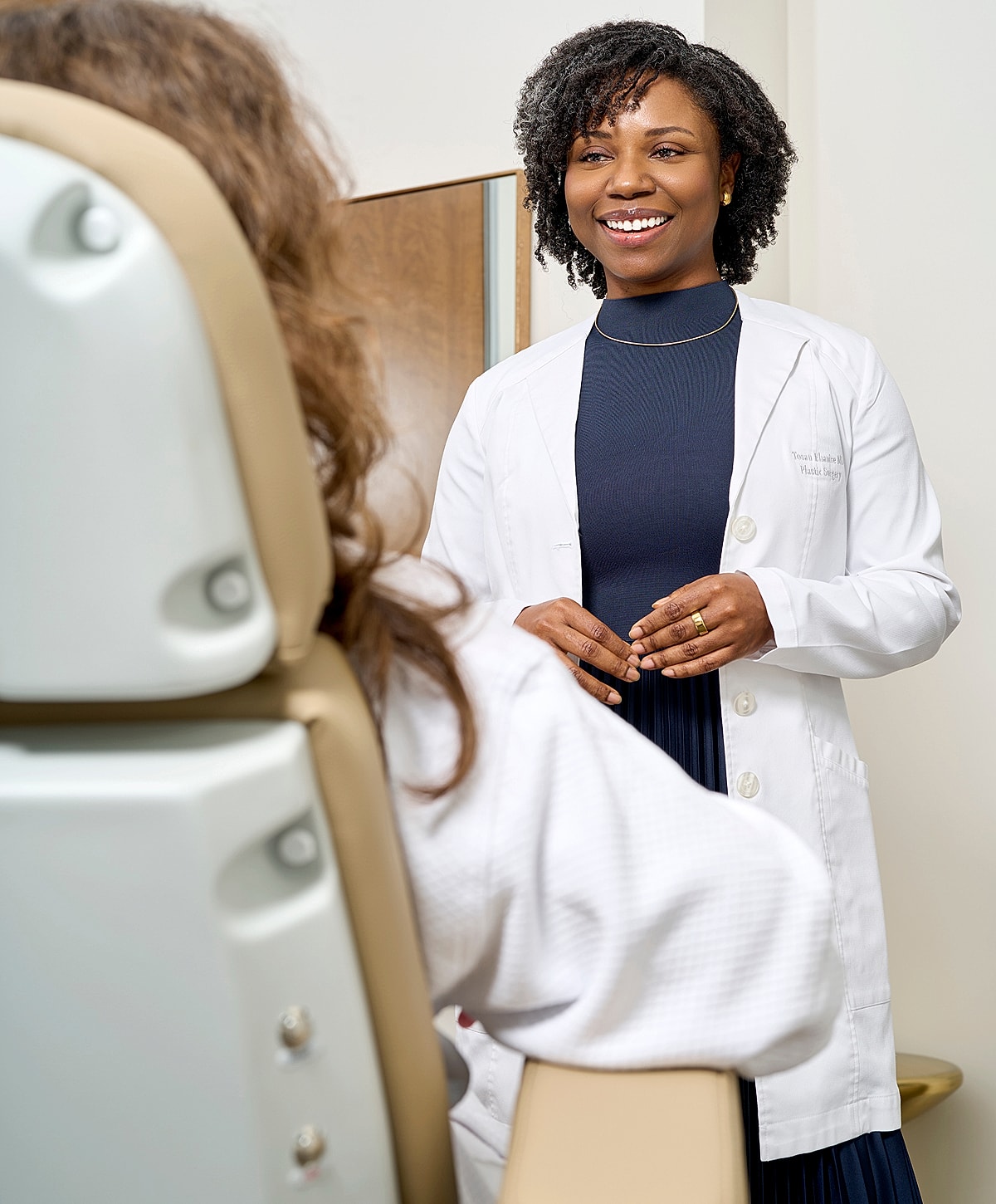
Because tissue expanders are temporary devices, they feel firm to the touch and serve as a structural bridge toward your final result. Once the skin envelope has expanded and rested, Dr. Ehanire performs a shorter, outpatient stage-two procedure to replace the expander with a breast implant.
The final result is a soft, warm, and natural-looking reconstructed breast mound that restores your silhouette, clothing fit, and personal confidence for years to come.
Navigating staged breast reconstruction requires a skilled reconstructive surgeon who possesses elite technical expertise, a deep understanding of oncologic care, and genuine human empathy. At Align Plastic Surgery in Austin, TX, board-certified plastic surgeon Dr. Tosan Ehanire approaches tissue expander placement with clinical rigor and warm care. Bringing elite training from Duke, Johns Hopkins, and the University of Florida, Dr. Ehanire collaborates seamlessly with your breast cancer surgeon, taking the extra time needed to prepare your foundation so you can heal with complete confidence and peace of mind.
In-office saline injections are generally well-tolerated. Because mastectomy surgery severs superficial skin nerves, you will feel little to no needle discomfort. You may experience a mild feeling of tightness or pressure across the chest wall for 24 to 48 hours after a fill, which is easily managed with over-the-counter care or mild medication.
Expansion visits are typically scheduled once a week or every two weeks in our Austin office until your target breast volume and shape are achieved. Most patients complete expansion in 4 to 8 visits.
Once expansion is complete, the expander stays in place for approximately 1 to 3 months to allow the skin envelope to stretch and settle comfortably. If you require post-mastectomy radiation therapy, the exchange procedure is typically scheduled 3 to 6 months after radiation finishes.
No. You should sleep on your back, elevated on pillows, during the entire expansion phase to prevent pressure on the device and avoid disrupting healing tissue layers.
Yes. Under the federal Women's Health and Cancer Rights Act (WHCRA), health insurance plans that cover mastectomies are required by law to cover all stages of reconstruction—including tissue expanders, implant exchange, and symmetry procedures on the opposite breast.