Earlobe Repair
Earlobe repair is an in-office procedure designed to restore stretched, torn, or split earlobes to their clean, natural, and symmetrical form.


Earlobe repair is an in-office procedure designed to restore stretched, torn, or split earlobes to their clean, natural, and symmetrical form.
Earlobe repair (lobuloplasty) is chosen by patients who want to correct torn, stretched, or gauged earlobes and return to wearing earrings with ease and confidence. At Align Plastic Surgery, board-certified plastic surgeon Dr. Tosan Ehanire meticulously reconstructs damaged earlobe tissue while utilizing evidence-based scar protocols, helping every patient enjoy smooth, discreet, and symmetrical results.


Earlobe repair, or lobuloplasty, is an in-office surgical procedure designed to repair and reshape earlobe soft tissue that has been damaged over time or through sudden trauma.
Whether caused by decades of wearing heavy earrings, accidental snags, or deliberate ear gauging, the delicate earlobe tissue can lose its structural integrity and split or stretch beyond its natural resilience.
During the procedure, patients have options depending on their specific anatomy and goals—from simple split closures and hole tightening to complex tissue redistribution for previously gauged lobes. The overall purpose of our Austin earlobe repair is to excise internal scar tracts, re-approximate healthy tissue layers, and restore a smooth, rounded, and natural earlobe rim that blends harmoniously with your facial features.

A Healing Hand
On surgery day, Dr. Ehanire begins by personalizing and marking the exact surgical lines on your earlobes while you are comfortably seated, ensuring absolute geometric symmetry between both sides.
Gentle local anesthesia is administered directly into the earlobe, numbing the tissue completely within seconds. Dr. Ehanire then precisely excises the stretched, scarred, or split margins using delicate micro-surgical instruments. She aligns and sutures the tissue in multiple layers to prevent border notching along the rim, repairing both the deep soft tissue foundation and the outer skin. The entire process takes approximately 30 to 45 minutes per earlobe, after which you can immediately return home or to work.

With earlobe repair Austin patients can effectively address a variety of congenital, traumatic, and age-related soft tissue concerns affecting the lower ear:
Full Earlobe Tears (Split Lobes)
Complete vertical separation of the earlobe rim caused by heavy jewelry or sudden accidental pulling.
Partial Tear Elongation
Stretched, enlarged earring holes that prevent studs from sitting upright or cause jewelry to fall through.
Gauged Earlobes
Large tissue openings remaining after wearing body-piercing gauges, plugs, or stretchers.
Aged or Thinning Earlobes
Wrinkled, deflated, or elongated earlobes resulting from natural volume loss and gravity over time.
Asymmetrical Lobules
Irregular earlobe borders or uneven shapes resulting from prior ear trauma or improper original piercings.
Earlobe repair in Austin specifically targets the soft, non-cartilaginous lower third of the ear (the lobule), focusing on the piercing tract, tissue margins, and inferior earlobe rim.

Earlobe repair offers immediate aesthetic, functional, and personal benefits by removing distraction and restoring quiet balance to your appearance.
Restores a smooth, rounded, and natural border along the bottom edge of the earlobe, eliminating unsightly splits, gaps, or elongated openings.
Dr. Ehanire utilizes multi-layer microscopic closure techniques and specialized scar care protocols to ensure incisions heal as thin, flat, and discreetly as possible.
Once the tissue has fully healed and regained structural strength, you have the freedom to safely re-pierce your ears and wear your favorite jewelry again with confidence.
Ideal candidates for earlobe repair are healthy adults seeking to correct split, stretched, or torn earlobe tissue to restore symmetry and structural strength.
Good Candidates Include:
Who May Not Be an Ideal Candidate:

Recovery from earlobe repair is exceptionally mild, requiring virtually no downtime from your daily activities.
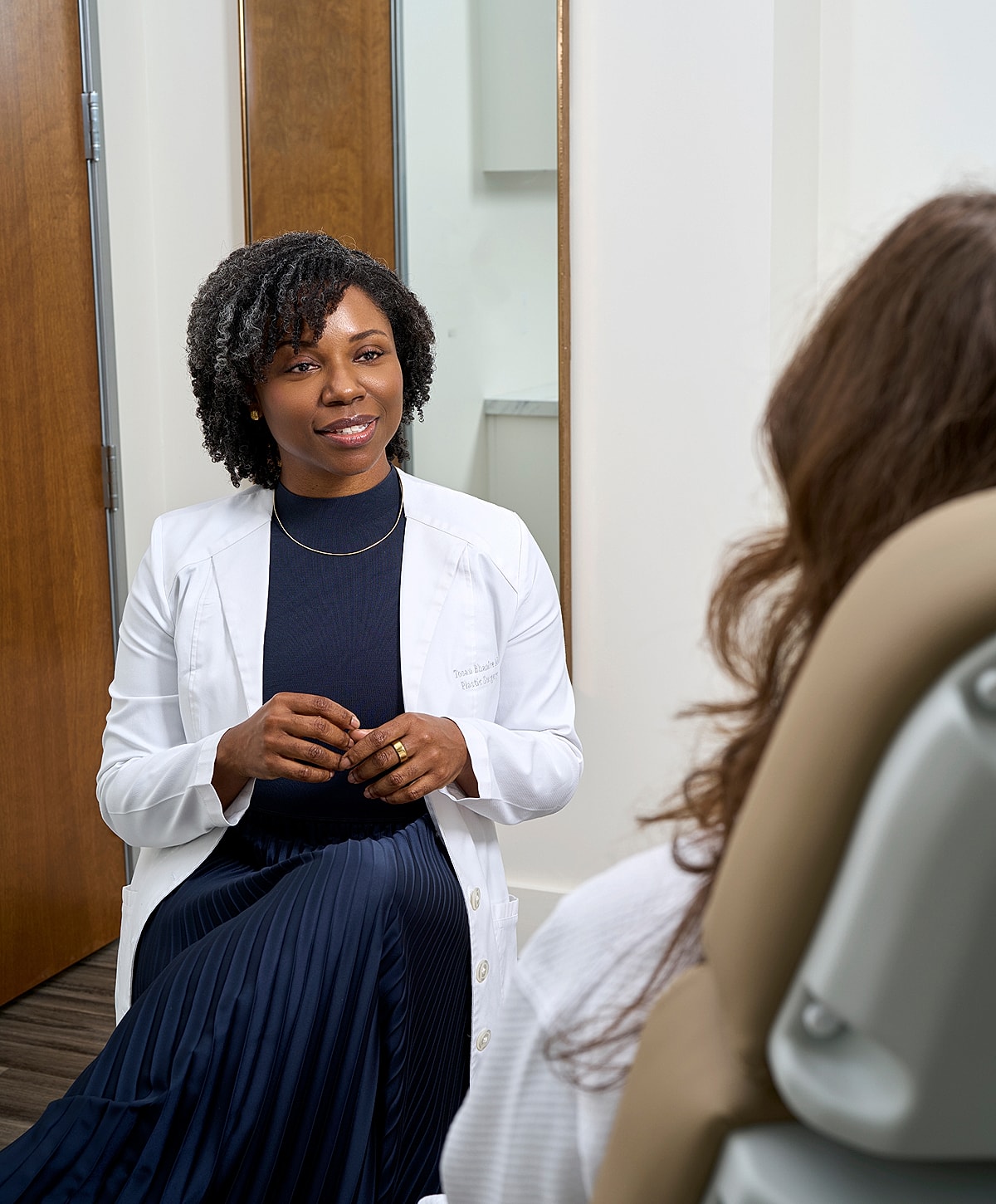
Drawing from her dedicated research background in cellular wound recovery and scar physiology, Dr. Ehanire provides step-by-step aftercare instructions to soften and flatten the incision, ensuring optimal outcomes across all skin tones throughout your recovery journey.
Expect mild tenderness or light swelling, which can be easily managed with over-the-counter pain medication. You will keep the incision clean and dry while applying a thin layer of prescribed ointment.
The incision line will appear cleaner, thinner, and well-approximated.
Underlying tissue continues to build structural strength. Light activities can be resumed immediately, though direct pressure on the ears should be avoided.
Ears can typically be re-pierced after 8 to 12 weeks of tissue maturation, placed slightly off-center from the original scar line to preserve tissue integrity.
The structural results of earlobe repair are immediate and permanent. As initial post-operative redness fades over a few short months, the fine incision matures into a discreet, subtle line that blends into the natural texture of the earlobe.
With proper care and guidance from Dr. Ehanire, your earlobes will permanently maintain their smooth, rounded shape. Should you choose to re-pierce your ears after healing is complete, following simple weight guidelines for future jewelry will keep your earlobes healthy, symmetrical, and beautiful for decades to come.
Even the smallest procedure deserves uncompromising attention to detail. At Align Plastic Surgery, Dr. Tosan Ehanire approaches earlobe repair with the same meticulous precision and artistic integrity as complex microsurgical reconstructions. She listens attentively to your concerns, evaluating tissue dynamics with scientific care, and delivers a post-recovery experience where people see your results, not your scars.
Earlobe repair typically takes 30 to 45 minutes per earlobe, depending on whether the tear is split, elongated, or previously gauged.
Dr. Ehanire recommends waiting at least 8 to 12 weeks after surgery before re-piercing your earlobes. Re-piercing should be done slightly off-center from the surgical scar line to preserve tissue strength.
Dr. Ehanire utilizes multi-layer microscopic closure techniques and specialized scar care protocols to ensure incisions heal as thin, flat, and discreetly as possible. Over time, the fine scar matures into a subtle line hidden in the natural earlobe texture.
No. The procedure is performed under local anesthesia, which completely numbs the earlobe. Patients experience no pain during surgery and only mild, easily manageable tenderness for a day or two afterward.
Yes. Repairing gauged earlobes requires removing excess stretched skin margins and carefully redistributing tissue volume to rebuild a rounded, natural earlobe shape.
Because split or stretched earlobes are typically caused by heavy jewelry or cosmetic stretchers, earlobe repair is considered an elective cosmetic procedure and is generally not covered by insurance. Our practice offers clear, transparent pricing during your consultation.